The resin-bound system, explained

What resin-bound stone actually is, how the layers stack up, how we install it, and the real numbers behind it — written plainly so you can read a quote like a builder and compare apples with apples. Serving Geelong, the Bellarine & Surf Coast.

Resin-bound only UV-stable aliphatic resin Permeable over a permeable base 5-year written guarantee Specs verified against the TDS

House and context images on this page are indicative renders to show the look and setting — not photos of completed Terralume jobs. Technical values are indicative and verified against the product TDS/SDS on every job.

Start here

Resin-bound vs resin-bonded — they're not the same thing

The two names look almost identical and get used interchangeably in ads, but they're genuinely different builds with different performance. Terralume installs resin-bound only. Here's the honest difference.

What we do · Resin-BOUND

Resin-bound — mixed all the way through

Every stone is coated in clear, UV-stable resin in a forced-action mixer, then trowelled on site as one homogeneous layer. The aggregate is bound throughout the depth — not just glued on the face.

  • Smooth, seamless finish — trowelled flat and joint-free.
  • Permeable-capable — water can pass through the surface when it's laid over a permeable, open-graded base.
  • Stays put — stone is locked in through the full depth, so there's no loose gravel underfoot or under tyre.
  • Ideal for driveways, patios, pool surrounds and paths.

Think of it like nougat — the resin runs all the way through the mix, not just over the top.
For contrast · Resin-BONDED

Resin-bonded — a scatter-coat on top

Resin is squeegeed onto a solid base, then dry stone is scattered over the wet film and the loose excess is swept off. The stone sits in a single layer on the surface — it isn't mixed through.

  • Impermeable — the resin film seals the base, so water sheets off the surface rather than draining through.
  • Sheds stone — because grit is only adhered to the top, it can work loose over time.
  • Has a rougher, grittier texture than a bound, trowelled finish.
  • Often promoted as anti-slip — but it has its trade-offs.

Both are legitimate systems with their place — but they perform differently, so it's worth knowing exactly which one a quote is for.

The build-up

How a resin-bound surface is built, layer by layer

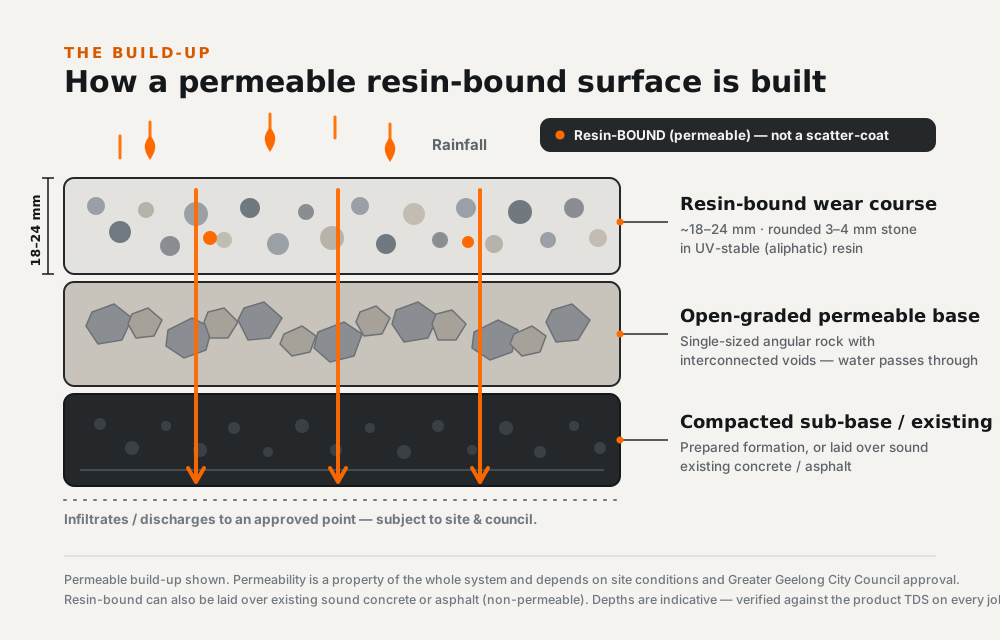
Permeability and durability aren't down to the resin alone — they're properties of the whole build-up. Here's how the layers stack, from the stone you walk on down to the ground.

Labelled cross-section of a resin-bound surface: an 18 to 24 millimetre resin-bound wear course of rounded 3 to 4 millimetre stone on top, an open-graded permeable base with interconnected voids in the middle, and a compacted sub-base or existing slab below, with orange arrows showing rainfall draining down through the layers to the ground.
Indicative cross-section. Permeable build-up shown. Depths and base build-up vary by site, loading and council requirements, and are verified against engineering and the product TDS on every job.
1

Resin-bound wear course

Naturally rounded ~2–5 mm kiln-dried aggregate, mixed all the way through a clear, two-part aliphatic (UV-stable) polyurethane at about 7% resin by weight, then trowelled flush on site. This is the surface you see and walk on.

~15–18 mm pedestrian · ~18–24 mm driveway
2

Open-graded permeable base

A clean, single-sized angular base with interconnected voids lets water pass straight through rather than pooling on top. This open structure is the part that makes the system permeable.

Depth designed to site & loading
3

Compacted sub-base & formation

A compacted sub-base over a prepared formation carries the load and directs water down to the ground or to an approved discharge point.

Engineered to suit the job
4

Or: laid over sound concrete / asphalt

Where permeability isn't required, the same wear course bonds over an existing sound, non-permeable slab — no demolition needed. This route is hard-wearing but not permeable.

Non-permeable route
i

Permeability is engineered, not assumed

Drainage performance follows from base depth, void structure, soil, slope and the discharge point — all confirmed on site and against engineering, never promised off a brochure.

ii

Two honest routes, one finish

Whether we build a permeable base or lay over a sound existing slab, the wear course you walk on looks and feels the same — the difference is what happens to the water underneath.

iii

Depths set by loading, not by guesswork

Pedestrian areas are laid thinner than driveways for a reason — the wear course depth is matched to the traffic it carries and verified against the product TDS.

The install

From first call to finished surface

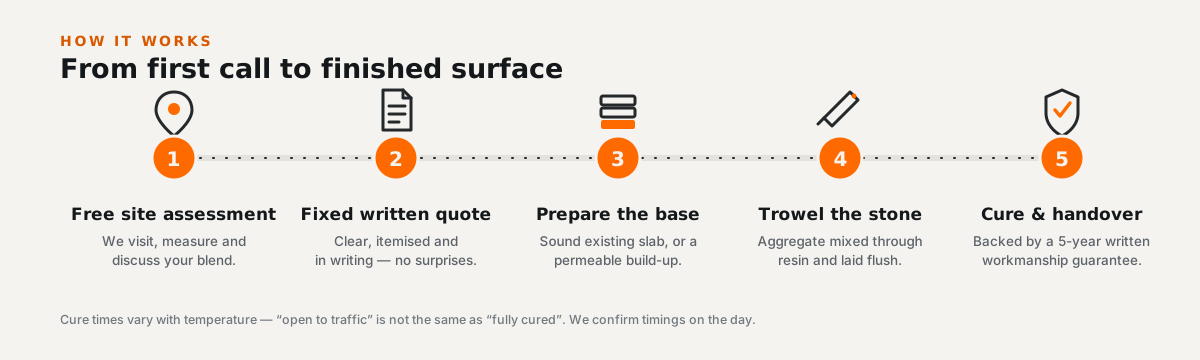
Five clear steps. You'll always know what's happening on your site, when, and why — and the timeline goes in your written quote before any work starts.

Five-step install process shown as numbered stages: 1 free site assessment where we visit, measure and discuss your blend; 2 fixed written quote, clear and itemised; 3 prepare the base, either a sound existing slab or a permeable build-up; 4 trowel the stone, with aggregate mixed through resin and laid flush; and 5 cure and handover, backed by a 5-year written workmanship guarantee.
Our five-step process. Cure times vary with temperature — "open to traffic" is not the same as "fully cured", and we confirm timings on the day.
1

Free site assessment

We visit, measure up, check the existing base and bring real stone samples so you can see your shortlisted blend in daylight against your home — not just on a screen.

2

Fixed written quote

A clear, itemised quote setting out the blend, depth, base approach, drainage and timeline — fixed before we start, so there are no surprises later.

3

Prepare the base

We lay over a sound existing slab, or build a permeable open-graded base where free drainage is the goal — the foundation that does the structural and drainage work.

4

Mix & trowel the stone

Aggregate and resin are batch-mixed to ratio in a forced-action mixer, then trowelled flush by hand for a smooth, seamless, joint-free finish.

Step 5
5yr

written workmanship guarantee

Cure & handover

Once the surface is safely open to use, we walk it with you, hand over a plain-English care guide, and provide your 5-year written workmanship guarantee. We confirm the day's cure timings on site — "open to traffic" is never the same as "fully cured", and we don't rush it.

See the full cure timeline below ↓
Honest comparison

How it compares

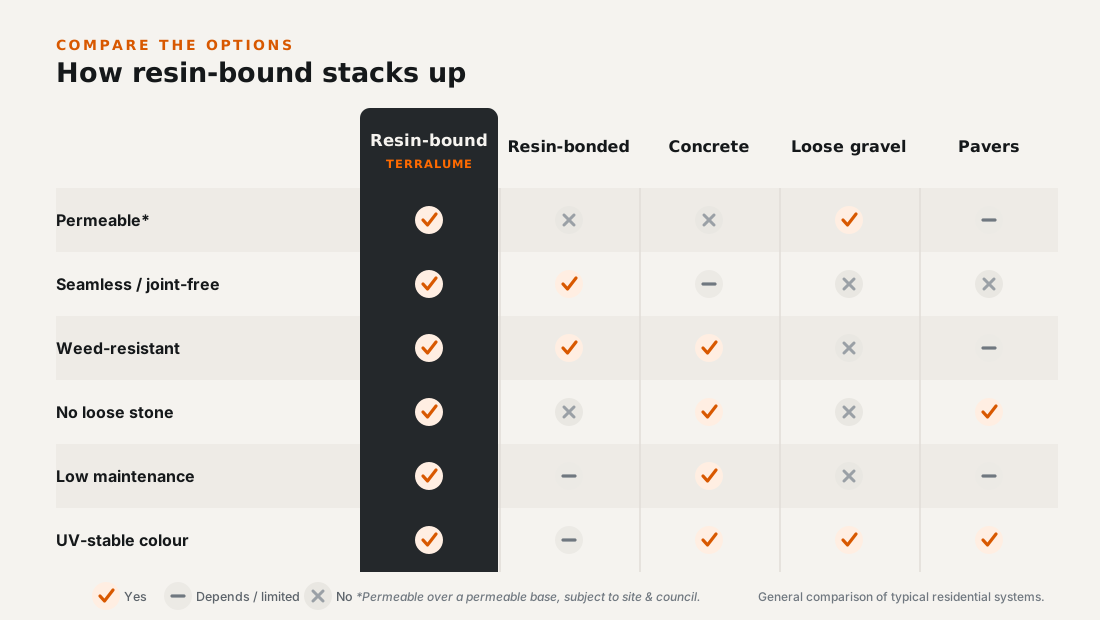
A plain look at resin-bound stone against other common surfaces. Every surface has its place — this just shows where resin-bound earns its keep.

Comparison matrix of resin-bound stone against resin-bonded, concrete, loose gravel and pavers, scored across permeability, a seamless joint-free finish, weed resistance, no loose stone, low maintenance and UV-stable colour. Resin-bound scores strongly across the board, with permeability noted as available over a permeable base.
General comparison of typical residential systems. Actual performance depends on the product, base and installation. Resin-bound is permeable only when laid over a permeable base, subject to site & council. Terralume installs resin-bound only.
The numbers

The indicative spec, in plain figures

These are the working numbers behind a resin-bound surface. We write them as ranges because real jobs vary — and we never overstate. Every value is verified against the product TDS/SDS before we lay.

~2–5mm
Aggregate size
Rounded, kiln-dried natural stone (max ~6 mm)
~25–30kg/m²
Coverage
Densely packed and bound flush
~7%
Resin dosage
By weight, two-part aliphatic PU
5yr
Written guarantee
Plain-language workmanship cover
Full resin-bound spec sheet — indicative
Aggregate ~2–5 mmNaturally rounded, kiln-dried natural stone. Larger blends up to a max of ~6 mm.
Coverage ~25–30 kg/m²Aggregate laid densely and bound flush, varying with depth and stone size.
Resin dosage ~7 %Resin by weight of aggregate (typically ~6.5–8%), batch-mixed to the product ratio.
Binder Aliphatic PUTwo-part aliphatic polyurethane — UV- and colour-stable. (Cheaper aromatic resins yellow outdoors, so we don't use them.)
Depth — vehicular ~18–24 mmDriveways and garage approaches, over a suitable prepared base.
Depth — pedestrian ~15–18 mmPatios, pool surrounds and pathways.
Base Two routesSound existing concrete or asphalt, or a permeable open-graded build-up for free drainage.
Cure — foot traffic ~6–8 hAt ~20 °C. You can walk on it — but it isn't fully cured yet.
Cure — light vehicle ~24–72 hAt ~20 °C. Driveways take a car once this milestone passes.
Cure — full ~7 dFull chemical cure at ~20 °C. All cure times lengthen in cold or winter conditions.
Guarantee yrPlain-language written workmanship guarantee.

All technical values are indicative and verified against the product Technical Data Sheet (TDS) and Safety Data Sheet (SDS) on every job. "Open to traffic" is not the same as "fully cured".

What to expect after we lay it

Cure timeline at about 20 °C. These are conservative buffers above the resin manufacturer's TDS minimums — your installer confirms the day's timings on site.

~6–8h

Open to foot traffic

You can walk on the surface — but it hasn't reached full strength yet.

~24–72h

Open to light vehicles

Driveways can take a car once this milestone passes.

~7d

Full chemical cure

The resin reaches its full hardness, strength and chemical resistance.

Cold & winter installs

All of the above lengthen in cooler weather — we never rush a cure.

Drainage & WSUD

Permeable is a property of the whole system

Resin-bound stone can be a genuinely free-draining, Water Sensitive Urban Design (WSUD) surface — but only when the whole build-up is designed for it. The wear course alone doesn't make a surface permeable; the open-graded base beneath it does the work.

Permeable over a permeable base

Lay the bound wear course over an open-graded, free-draining base and water passes through the surface to the ground — instead of sheeting off into the gutter. Over a sealed slab, it isn't permeable.

WSUD-friendly, the Victorian way

A permeable build-up supports Water Sensitive Urban Design (WSUD) — the Victorian / Melbourne Water approach to managing stormwater at the source — by letting rain soak in near where it falls.

Subject to your site & council

Real drainage performance depends on soil, slope, water table and the discharge point — and on approval from the Greater Geelong City Council. We design the build-up to suit, and we won't promise what a site can't deliver.

Honest wording: resin-bound "drains freely over a suitable permeable base", subject to site conditions and council approval. We never claim "100% permeable", "no puddles" or "drains instantly".

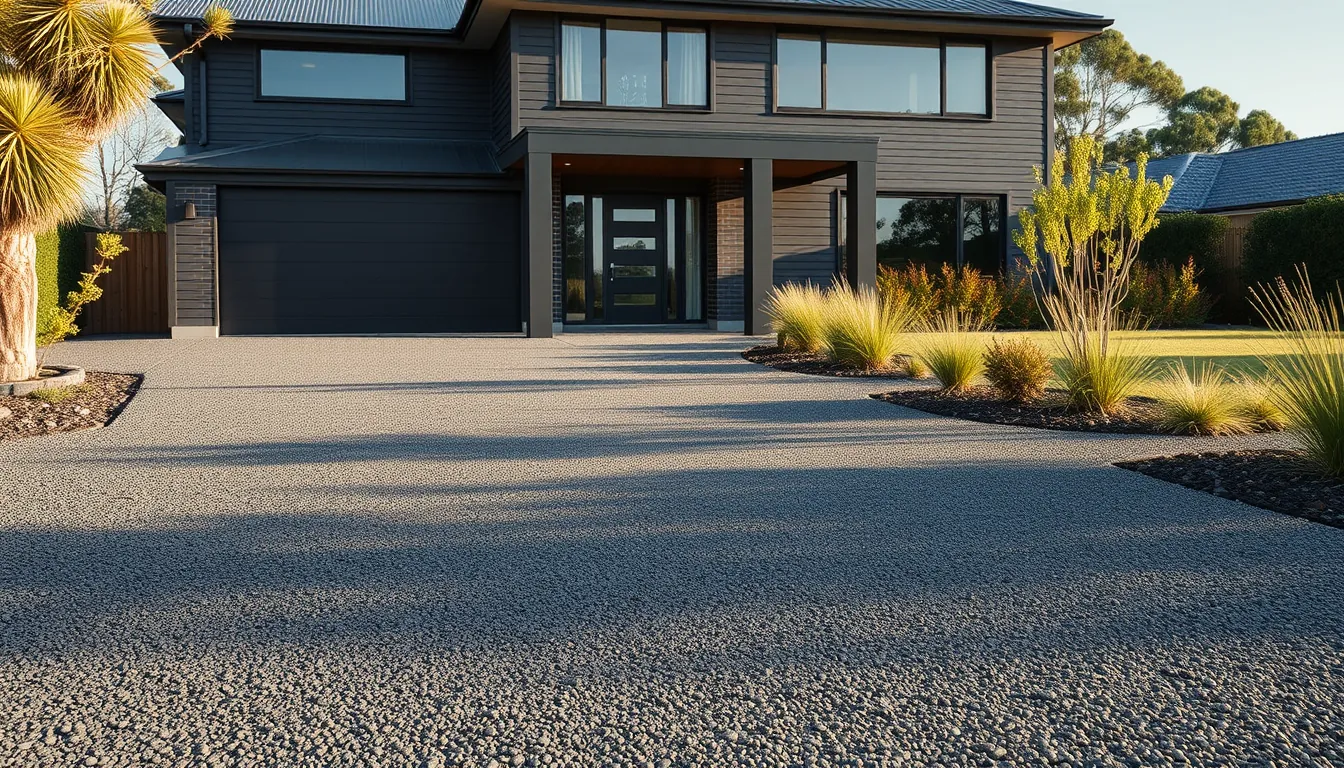
Indicative render of a modern two-storey home with a seamless resin-bound stone driveway in a warm sandstone blend curving up to a double garage, bordered by neat green lawn Indicative render
Indicative render of a resin-bound driveway — to show the look and setting, not a photo of a completed Terralume job.
The Terralume standard

Same system, done properly

Resin-bound is only as good as the hands that lay it and the materials that go into it. These are the standards we hold every job to — the things that separate a surface that lasts from one that looks the part for a season.

01

UV-stable resin, not the cheapest tin

We specify a two-part aliphatic polyurethane chosen to hold its colour outdoors. Cheaper aromatic resins yellow in sunlight — a false economy you only notice after a couple of Australian summers, so we don't use them.

02

Batch-mixed to ratio, trowelled by hand

Every batch is mixed to the product's resin ratio in a forced-action mixer and laid by hand to a consistent depth. Under-dosed or rushed mixes are where loose stone and weak spots come from — so we mix it right, every time.

03

The base gets the same respect as the surface

Most surface failures start underneath. We assess your existing slab honestly and either lay over a sound base or build a proper permeable one — we won't trowel a beautiful finish over a base that's going to move.

04

Specs verified against the TDS — on paper

Aggregate, depth, dosage and cure are confirmed against the manufacturer's Technical Data Sheet for your chosen blend and written into your quote, so you can hold the numbers to account rather than take them on trust.

05

Local to Geelong, the Bellarine & Surf Coast

We work to this region's weather, soils and council requirements, and we back the workmanship with a plain-language 5-year written guarantee and your protections under the Domestic Building Contracts Act 1995 (Vic).

We're a new Geelong business building our portfolio the honest way — customer reviews and completed-job photography are coming soon. Until then, everything on this page is the genuine, spec-accurate system you'll receive, not borrowed marketing.

Good to know

How it works — your questions

Straight answers to the questions we hear most about the resin-bound system.

Is resin-bound the same as resin-bonded?

No. Resin-bound mixes every stone through the resin and trowels it on as one smooth, permeable-capable layer — that's what we install. Resin-bonded scatters dry stone onto a wet resin film, which seals the base (so it's impermeable) and can shed loose grit over time. The names look alike, so always check which system a quote is actually for.

Is a resin-bound surface really permeable?

It can be — but permeability is a property of the whole build-up, not the resin alone. Laid over a permeable, open-graded base it drains freely; laid over a sealed concrete slab it does not. Real performance also depends on your soil, slope and discharge point, and on Greater Geelong City Council approval. We design the base to suit your site, and we never claim "100% permeable" or "no puddles".

How thick is it, and how much stone goes into it?

We lay at about 18–24 mm for vehicular areas like driveways and about 15–18 mm for pedestrian areas like patios, paths and pool surrounds. Coverage is roughly 25–30 kg/m² of naturally rounded ~2–5 mm kiln-dried aggregate (up to a max of ~6 mm on some blends), bound at about 7% resin by weight. All values are indicative and confirmed against the product TDS for your chosen blend.

What resin do you use, and will it yellow in the sun?

We specify a manufacturer-backed, two-part aliphatic polyurethane — chosen because it's UV- and colour-stable outdoors. Cheaper aromatic resins yellow in sunlight, so we don't use them. The aim is a finish that holds its colour rather than the cheapest tin on the shelf.

How long before I can walk and drive on it?

At around 20 °C, you can typically walk on it after about 6–8 hours, drive a light vehicle on it after about 24–72 hours, and it reaches full chemical cure at around 7 days. Cold or winter conditions lengthen all of these — and "open to traffic" is not the same as "fully cured". We confirm the day's timings on site and never rush a cure.

Can you lay it over my existing concrete or asphalt?

Often, yes. If your existing slab is sound, the bound wear course can be laid straight over it — no demolition needed (this route is hard-wearing but not permeable). If the base is cracked, soft or moving, it may need repair or a new build-up first, and where you want free drainage we build a permeable open-graded base instead. We assess this at your free site visit and put the right approach in your quote.

Will it crack, and is it guaranteed?

Resin-bound is flexible and joint-free, so it resists cracking far better than rigid concrete — though no outdoor surface is entirely crack-proof, especially over a moving base. Every Terralume install comes with a plain-language 5-year written workmanship guarantee, and your rights are also protected under the Domestic Building Contracts Act 1995 (Vic) and Consumer Affairs Victoria.

Do I need council approval?

It depends on the project and whether you're relying on the surface for stormwater management. Permeable-paving and drainage approvals are handled through the Greater Geelong City Council. We'll flag anything relevant at the site assessment so there are no surprises — and we design the build-up to suit your site rather than promising what it can't deliver. For advice, see our contact page.

How much looking-after does it need?

Very little. Because it's seamless and the stone is locked in, there are no joints for weeds to colonise and no loose grit to sweep up. Day to day, a periodic rinse or a gentle pressure-wash keeps it looking fresh, and a permeable surface clears surface water rather than holding puddles. We hand over a plain-English care guide at completion so you know exactly what helps and what to avoid.

How does it handle oil, leaves, heat and frost?

Once fully cured, the aliphatic resin is hard-wearing and chemically resistant, so the odd oil drip or fallen leaf cleans off rather than staining in. The surface copes with our local temperature swings and won't go brittle in winter the way some rigid surfaces can. Like any outdoor surface it isn't indestructible — but day-to-day weather, sun and seasonal mess are well within its comfort zone.

How does the cost compare to concrete or pavers?

Resin-bound usually sits above plain concrete and around the level of a quality paved or exposed-aggregate finish — it's a premium surface, and we won't pretend it's the cheapest option. Where it pays you back is over time: no weeding between joints, no loose stone to top up, no sealing every couple of years, and a seamless finish that doesn't date. We give you a fixed written price at quote stage so you can weigh it up honestly against the alternatives.

Ready to talk through your project?

Now you know how the system works — let's apply it to your site. We'll bring real stone samples to a free assessment, recommend the right spec, depth and base for the way you'll use it, and put it all in a fixed written quote backed by our 5-year workmanship guarantee. Serving Geelong, the Bellarine & Surf Coast.

Book a free site assessment
Get a free quote